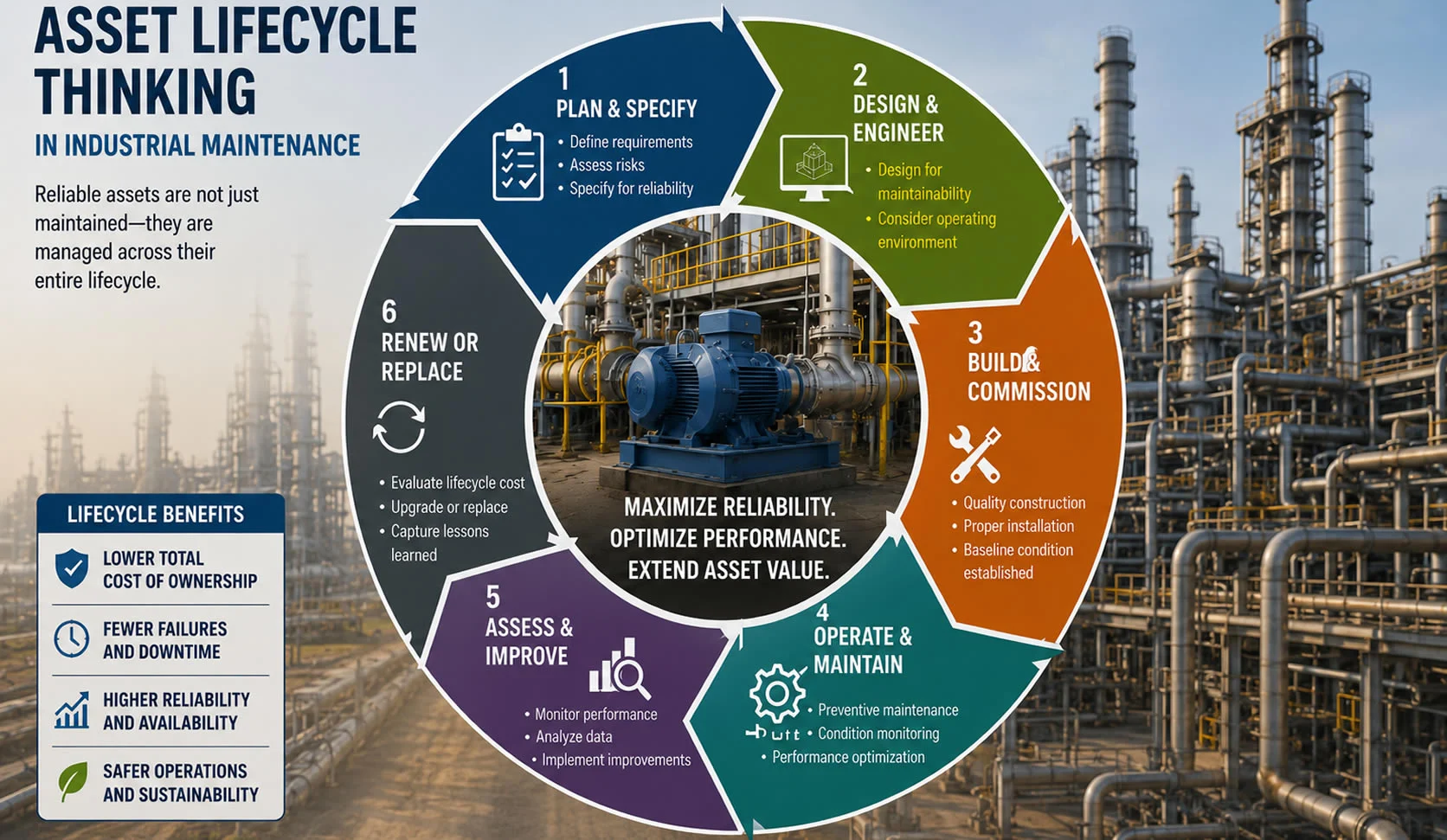


Author: Michael R. Hayes, Reliability & Asset Integrity Specialist
In many industrial operations, asset protection is still viewed as a surface-level activity: cleaning, coating, painting, or restoring equipment appearance. From a reliability engineering perspective, that view is incomplete.
Asset protection is not cosmetic. It is a risk-control strategy.
Critical assets in mining, oil & gas, power generation, marine, and heavy manufacturing operate under constant exposure to corrosion, abrasion, chemical attack, moisture, UV, heat, vibration, and mechanical wear. These mechanisms do not simply affect appearance; they reduce equipment function, structural integrity, inspection quality, and service life.
The economic impact is significant. The AMPP/NACE IMPACT study estimated the global cost of corrosion at approximately US$2.5 trillion, equivalent to about 3.4% of global GDP. AMPP also reports that applying available corrosion-control practices can reduce corrosion-related costs by 15% to 35%.
For reliability teams, the objective is not to “make equipment look new.” The objective is to slow degradation, preserve function, reduce failure probability, and maintain safe operating conditions.
A practical asset protection program should begin with one question:
What failure mechanisms are we trying to control?
Corrosion requires one approach. Abrasion requires another. Chemical attack, erosion, impact, UV exposure, moisture ingress, and thermal cycling each demand different protective methods.
The wrong protection system can create a false sense of security. For example, a coating that performs well under atmospheric exposure may fail quickly under immersion, chemical splash, or abrasive slurry. A lubricant designed for light-duty chains may not survive open gears, wire ropes, or high-load industrial equipment.
Asset protection should be connected to asset criticality. A conveyor frame, pump casing, storage tank, transformer housing, marine structure, crusher component, or gearbox may not require the same protection level, but each should be evaluated according to consequence of failure.
In aggressive environments, degradation is expected. Failure is not.
Key takeaway: Asset protection is a reliability discipline focused on preserving up time, safety, and service life.